SASSA Child Support Grant Guide – Amount, How to Apply & Status Check
Fast & flexible short term loans in South Africa from R100 to R5,000+
Apply NowRaising a child in South Africa is a real financial struggle, especially when you take into account the rising cost of groceries, the cost of school fees, and transport. However, you can get government help by applying for the SASSA Child Support Grant, which provides the financial support needed to raise a child in South Africa.
Whether you are applying for the grant for the first time, checking your SASSA payment status, or figuring out the difference between the government grants and the private child maintenance payments made by biological parents, we will explain everything you need to know.
We will explain everything you need to know about the SASSA Child Support Grant, from the actual amount you can expect to get each month to the eligibility and income criteria for an online application. This resource aims to give you clear and practical advice, tailored to the reality of South Africa.
What Is SASSA?
The South African Social Security Agency, also known as SASSA, is a government agency that helps people in need. It serves as a safety net for South Africans, making sure they receive the financial support essential for survival. SASSA is a part of the Department of Social Development and it was established in 2004 to provide financial help to people get the financial support that they need it, such as the elderly, war veterans, people with disabilities, foster parents, and families caring for children.
It also handles millions of payments each month across all nine provinces of South Africa by delivering money directly to people’s bank accounts. It also allows them to pick up at retail stores or at specific government subsidy payment points, which ensures that funds reach those who need them most.
How Does the SASSA Child Support Grant Work?
The SASSA Child Support Grant is a regular payment to help out the main caregiver of a child under 18. The main caregiver does not necessarily have to be the mum or the dad; it can be whoever is taking care of the child day-to-day, providing food, clothes, a roof over their head, and keeping an eye on them.
For example, that can be grandma, a younger sibling, an aunt or uncle, or even a guardian.
The main idea is to give people the money they need to cover the basics for their children, but to make sure it is going to the right people, SASSA uses a “means test”, where they check the income of the main caregiver before giving the grant.
How Much Is the SASSA Child Support Grant Per Child?
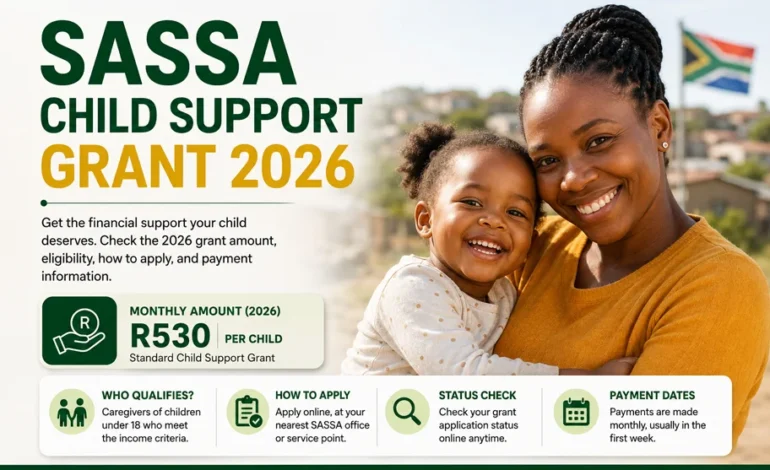
The standard monthly payout for the Child Support Grant is increased every year by the Minister of Finance in the National Budget Speech, in an effort to keep up with inflation. For the 2026 financial year, people with kids get around R530 each month for each of the children in their care who qualify for the grant.
If you are looking after three kids who are eligible for the grant and meet all the income requirements, you will get a separate monthly payment for each of them, all of which will be merged into a single payment.
| Grant Category | Monthly Payout (approximate 2026 rate) |
| Standard Child Support Grant | R520 per child / month |
| Child Support Grant Top-Up | R720 per child / month |
| Foster Child Grant | R1,180 per child / month |
Who Qualifies for the R720 Child Grant?
If you have been approved for the Child Support Grant Top-Up, you have a good chance of getting the higher R720 Child Grant. This higher payment was created by the Department of Social Development to help out relatives who are looking after kids who have lost one or both of their parents, without having to go through getting a formal Foster Child Grant, which can take a long time.
To be eligible for this R720 monthly payment:
- You have to be the one taking care of the orphaned child, essentially being their primary caregiver.
- If something has happened to the Child’s biological parents, either both have passed away, or the one parent has gone, and the other one is either missing or in prison.
- You also need to provide proof that the parents are no longer around, which means getting copies of death certificates for the deceased parents or getting official police and social worker confirmation that the surviving parent is either a no-show or in a situation where their whereabouts are unknown.
How Much Is a Child Support Grant for the First Time?
When you are first approved for a Child Support Grant, your first monthly payment will be much higher than usual. This is because SASSA pays you back for every month since you first applied.
For example, if you applied on January 15 and SASSA verified your documents by April 15, you will be approved then. In May, your payment will include the amounts for January, February, March, April, and May, all in one payment. After that, your monthly payments will return to the standard amount.
What Is the Lowest Amount for Child Support?
When it comes to state grants, SASSA doesn’t have a sliding scale; you either qualify for the full standard R530 or a Top-Up amount of R720, or you get nothing if you are unable to qualify for either one.
When a South African Magistrate’s Court orders private child maintenance, there is no fixed minimum amount. In these cases, the court will assess the child’s actual monthly needs, such as food, electricity, school fees, medical care, and how much each parent is able to contribute.
However, in some cases, a magistrate may even order a low-income parent who is not working to pay as little as R100 a month, if it is a fair reflection of what they can actually afford.
What Is the Maximum Child Support You Can Pay?
Under the South African Maintenance Act (Act 99 of 1998), there’s actually no limit on how much you can be asked to pay for child support; the law doesn’t actually put a cap on private child maintenance payments.
In South Africa, a child is entitled to a standard of living that matches the lifestyle of both parents, so if the other parent is earning around R150,000 a month, you could end up ordered to pay around R20,00 or even more each month in child support, depending on the child’s expenses.
Who Qualifies for the SASSA Child Grant Top-Up?
The Child Support Grant Top-Up is aimed at families where a death has resulted in children being looked after by informal relatives instead of their parents. You will be eligible for the Top-Up if the following apply to you:
- The child has to be under 18 and be living full-time with you in South Africa.
- You are a grandparent, cousin, aunt, uncle, or even just a family friend who is taking on the care of an orphan.
- You will need proof that the child is an orphan, like the official documents from the Home Affairs department.
- You also need to pass the regular SASSA means test for caregivers to ensure your income is lower than the required amount.
Where can the SASSA Child Support Grant payment be received?
SASSA lets you access your monthly grant cash from anywhere in South Africa, whether it is in the middle of a city or a rural village.
- Your Personal Bank Account: They will transfer the cash directly into your bank account through EFT at any bank that is licensed to do business in South Africa, like Capitec, Standard Bank, FNB, ABSA, etc.
- Postbank / SASSA Gold Card: You can collect your grant at any Postbank or at an ATM in town using your special government card.
- Retail Cash Pickups: You can also get the cash at shops like Pick n Pay, Shoprite, and Checkers, where you will just need to show your ID and cell phone to confirm the transaction.
- Mobile Money Transfer: Some mobile payment options have also made it easier to get your grant sent to you through text message using your mobile number.
What documents are required to apply for the SASSA Child Support Grant?
To apply, get approved for the SASSA Child Support Grant, and prevent rejections, you need to gather the following verified documents before initiating the application.
- Original 13-digit South African ID of the caregiver.
- The child’s birth certificate with a valid South African ID card.
- You need the bank statements of the last 3 months or a payslip, and if you are unemployed, you will need a SAPS affidavit declaring zero income.
- A certified copy of a marriage certificate, a decree of divorce, or the spouse’s death certificate.
- If the child is an orphan, you would need the death certificates of both biological parents, which is for Top-Up only.
How Much Is Child Support from a father in South Africa?
Biological fathers in South Africa have to meet a straightforward legal obligation under the Children’s Act; they have to help out financially with their kids. It does not matter whether they were ever married to the mother, or if they get to see their child on a regular basis.
To determine exactly how much a father has to pay each month, the Courts use a pro-rata calculation where they add up the net income of both the mother and the father together to come up with a total household income. Then they work out how much of that the child needs to be looked after, in proportion to the income of the parents who earn the most.
How to Apply Online for a SASSA Child Grant?
Applying online makes it possible to ignore the ridiculously early morning lines, which start in front of the SASSA offices. To start your application, follow these simple steps:
- Visit the online Portal: Use your computer or smartphone to visit the official SASSA website (sassa.gov.za).
- Create your account: Click on the register option, and enter your South African ID number, full name, email address, mobile number, and your email ID.
- Get Verified through OTP: The website will send a One-Time Password (OTP) via text, and enter it to confirm your identity.
- Choose Grant Type: Log in to your account, click the button marked “Apply for a Grant”, and pick Child Support Grant from the list.
- Fill Out the Application: Fill in your financial details, home address, and your child’s personal details, and double-check it for clarity.
- Upload your Documents: Upload clear digital copies of your ID, the child’s birth certificate, bank statements, and proof of where you live. Also ensure the bank statements are not older than 3 months.
- Submit it & save it: Click the submit button, and screenshot the unique SASSA Reference Number, which will help you track your application.
How Long Does It Take to Apply for the SASSA Child Grant?
The actual application submission can take as little as 30 to 60 minutes if you have all your certified documents sorted, but there is also a waiting period where SASSA can take anywhere from 30 to 90 days to be verified. Once they have verified everything through their systems, you will get an SMS notification about the approval.
Why does SASSA Child Grant take so long?
The primary cause of the delays is that SASSA must conduct extensive verification with other government departments, which is highly time-consuming.
- Verification with Home Affairs: They check every single ID number and birth certificate against the national population register to ensure there are no fake applications.
- High Volume of Applications: The local offices have to process millions of applications, resulting in long application queues, making the application process a lot slower.
- Bank Account: They also ensure that the bank account details on your application actually belong to you and whether it’s active or not.
- Means Test: They also verify your income with SARS and credit bureaus to make sure you are not hiding any income.
How can the SASSA Child Grant application process be sped up?
Even though the SASSA application process takes 1 to 3 months, you can still significantly speed up the process by preventing delays and by submitting a flawless application. These are the most effective strategies to ensure your SASSA application can move through verifications as quickly as possible.
- Apply Online: You should submit your application online because the digital process is significantly faster than physical in-branch applications.
- Submit correct Documents: Submitting the wrong application is the most common cause of delays, so you should always double-check the documents before submitting.
- Fresh Certifications: Make sure that all the certifications provided by you are not older than 3 months.
Warning Note: Remember that it is not possible to speed up the SASSA application by paying money to anyone, and the applications are 100% free. The agency has explicitly warned about guaranteed approval for money because many scammers exploit this misconception, so you should never pay a fee for an application to a third party.
Why might an affidavit be required to apply for a child grant?
During the SASSA application, you might need an affidavit for verification and as an alternative for missing documents. Depending on your situation, you may need to submit one or more of the following affidavits:
- Informal Housing: When you are living in an informal settlement, rural village, or in a backyard room without getting any formal utility bills in your name, you would need an affidavit to prove your residential address.
- Unemployment Declaration: If you don’t have any payslips or a bank account to prove your income, you will have to swear an oath that your monthly income is below the limit needed for the grant.
- Missing Biological Parents: If any of the biological parents has given up on the kid and their whereabouts are unknown, you will need an affidavit from the person looking after the kid and a social worker to explain why the biological parent is missing.
What Is the Income Limit for the SASSA Child Grant?
To get approved for the SASSA child grant, your income should not exceed R5,800 per month for single parents, and R11,600 per month for married couples. To get approved for a SASSA child grant, you need to pass a “means test”, which verifies whether you need the grant or not. It is done by verifying your bank transactions, assets, employment stability, investment, and other financial support before giving the grant.
How to Change Your SASSA Phone Number Online
If you have lost your SIM card or switched service providers, it is important to update your registered cell phone number quickly through the online portal, for fear of losing access to grant notifications:
- First, you need to visit the SASSA services portal, which can be found on services.sassa.gov.za.
- Scroll down the website till you find “Update Contact Details” or “Change your phone number” and click on it.
- Then, enter your 13-digit South African ID number and your personal Application Reference Number.
- Follow the instructions provided on the website, enter your new mobile number, and confirm the change by entering the OTP, which you will receive on the new SIM card.
- After that, wait for 24 to 48 hours, and your mobile number will be updated.
Why should you update your phone number?
Your mobile number is the key to secure interactions with SASSA’s online payment system, so if you don’t update your number, you can face various issues. These issues include missing payment confirmation texts and the potential danger of SIM-Swap Scams. It also makes it difficult to check on your status, as most of the services that you can use to check the status of your grant use your registered phone number.
Who Doesn’t Qualify for a Child Support Grant?
You will be automatically disqualified from getting the SASSA Child Support Grant if any of these situations come into play:
- Income Over the Limit: If your or your partner’s income is more than the R5,000 / R10,000 a month limit that SASSA uses for its means test.
- Getting Benefit Twice: If another person is looking after the child, or their biological parent, is already getting a SASSA grant for the same child.
- State Funding: If the child is living permanently in a state-run place such as a prison, a child and youth center, or a state boarding school, and that place is paid for by the government.
- Residential Status: The person applying, or the child, is not a South African resident and does not have permanent residence.
How to Get a Short-Term Loan Online When You Receive a SASSA Grant?
Many South African lenders target SASSA recipients with short-term cash loans, but if you are thinking of getting online credit and using your grant as proof of income, you will need to be safe and stay within the law.
- Check the NCR registration: You should only deal with credit providers who are properly registered with the National Credit Regulator (NCR). This is the easiest thing to check, as illegal lenders don’t have an NCR registration number displayed on their website or contract.
- Gather your Documents: Legit online lenders will need a copy of your ID, as well as 3 months of bank statements showing your SASSA grants are deposited, and they also want proof of your residence.
- Affordability Assessment: The NCA mandates all lenders to do a proper affordability assessment before giving you a loan to ensure you don’t end up with a loan repayment that covers up your entire grant, leaving you with not enough money to put food on the table for your family.
How to repay an online cash loan when you are on a SASSA grant?
Repaying the online cash loan when you are on a SASSA grant is necessary on time, because messing it up can have serious consequences, especially when you are already living off the government grant.
- Automated DebiCheck: The online lenders use automated DebiCheck to deduct the payment automatically from your bank account upon your consent, and prevent late payments.
- Making sure the payment and grant line up: The payments are made on the same days that SASSA puts money into your account each month. So, repaying the loan and interest happens automatically for you without any effort.
- Making manual repayments when possible: Some small lenders do let you pay back the loan by EFT using a unique number to send the payment, which you should use to lower your overall principal and thus interest rate.
Where Can you Get a Loan with Child Support Grant?
Yes, you can get a loan with a child support grant, as various bank in South Africa accepts the SASSA grants as valid proof of income. But it is also important to remember that SASSA does not provide any loans directly, and the repayment for the loans is capped at only 10% of your grant amount. This means that you can only borrow a smaller amount ranging from R500 to R2,500 over a period of 1 to 6 months.
SASSA Child Support Grant – FAQ Section
How to Contact SASSA?
For general questions from SASSA, application status information and payment dates, call the toll-free helpline on 0800 601 011 or email [email protected].
What happens if my child turns 18?
When your child turns 18, the grant will stop on the last day of the month when your child turns 18, and there will be no extension even if your child is still at school or university.
Can I apply for a grant for multiple children?
Yes, if you are the biological parent, then you can apply for all of your eligible children without having to worry about limits. However, if you are a non-biological carer, like an aunt or family friend who is looking after the kids, then you can only claim a grant for up to six children.
What if my SASSA Child Grant application is rejected?
If your application gets rejected, you have the right to appeal within 90 days after getting the formal rejection letter from SASSA. You only need to send up-to-date proof of income or an affidavit to dispute the means test if it is the reason for your rejection.
How long is the child grant valid?
The child grant is effective till the child turns 18, if your financial situation remains the same and the child is still living with you. But SASSA will still do an occasional review to make sure you are still eligible for the grant.
What if my circumstances change?
Under the Social Assistance Act, it is your responsibility to inform SASSA within 30 days if something major changes, such as getting married, getting a job that puts you over the limit, moving overseas, or if the child decides to move out of your household or has sadly passed away.
Can I apply if I’m not the parent?
Yes, you can apply for the grant because it is not strictly tied to the biological parents; it is for the person who’s doing the day-to-day parenting. If you are the one who’s actually raising the child, then you will need to get a letter from the biological parent for their permission to apply, or a report from a social worker to prove your responsibility.
How do I check my application status?
You can check your application status through a few different methods without needing to visit the local office by visiting www.services.sassa.gov.za, clicking on “Checking Application Status”, and entering your SASSA Reference number.
How do I check my grant balance?
If you are one of the people who use a SASSA Gold Card or a Postbank card, you can check how much cash is remaining on your account at any of the standard ATMs or for free at a Shoprite, Checker, or any other supermarket. But if your grant is directly paid into your bank, you can directly check your bank balance through the mobile banking app or use the USSD code for your specific bank.
When can my grant be stopped?
Your grant can be stopped for various reasons, which include failing to claim for 3 consecutive months, your child has turned 18, your income has increased over the required limit, or any fraud has been detected in your application.
What’s the difference between the SASSA Child Support Grant and child maintenance?
The SASSA Child Support Grant (CSG) is a welfare benefit which is provided by the government to financially struggling families to help them and their families survive.
However, child maintenance is a financial obligation that the biological or adoptive parents have to pay to meet the basic needs of the child, such as clothes, food, healthcare, and education.
Can I work while receiving the child grant?
Yes, you can definitely find work while receiving the child grant, as being employed does not automatically disqualify you from getting the help you need. As long as your earnings, either on your own or with your partner, are not high, you will still receive the grant. Single caregivers can earn up to R5,000 a month from a job, and married caregivers can earn up to R10,000 a month before they become ineligible.
Can I apply for SASSA child support if I am self-employed?
You don’t have to be tied down to a regular salary to be eligible for SASSA child support. Even if you are an informal trader, working from home, freelancing, or running a small business, you can fill out the application. However, to get approved, you will have to send your last 3 months’ bank statements and an affidavit from the police confirming your monthly income, so that SASSA can verify your income.
How do I access SASSA services if I have a disability?
You can get help from SASSA by visiting your nearest office or by visiting the website and booking a mandated medical assessment. And if your disability makes you unable to visit the branch office, you can inform the SASSA branch and ask if they can send an agent to your home, or you can also appoint someone you trust to act on your behalf.
Can I use another person’s ID to apply?
No, you cannot use another person’s ID to use in an application, as using someone else’s identity document to scam a grant is a serious crime in South Africa. It is against the fraud and identity theft law, so you need to apply using your own ID book or South ID Card.

George Desipris is an expert and passionate freelance content writer with 10+ years of experience in creating informative content for various websites, blogs, and other platforms. George is specialized in niche related to finance, especially in investment and trade.
Their writing hook the readers and never let them to search more about the topic. His articles also featured on various news websites like New York Times and Bloomberg. In addition, George Desipris enjoy chess and badminton like sports. He is always try to broaden their knowledge and vision by using his creativity skills.