
Understanding Interest Rates and Repayment Terms on Short-Term Loans in South Africa
Fast & flexible short term loans in South Africa from R100 to R5,000+
Apply NowShort-term loans are useful in financial crises, such as a car breaking down, as they provide the fastest and most accessible funds. However, jumping into a credit agreement without fully understanding the interest rates and repayment terms can turn this short-term relief into a long-term financial struggle.
This resource will help you understand how lenders actually calculate fees, what the maximum fees allowed by law under NCA are, and how you can protect your finances before signing a credit agreement.
What Are Interest Rates on Loans?
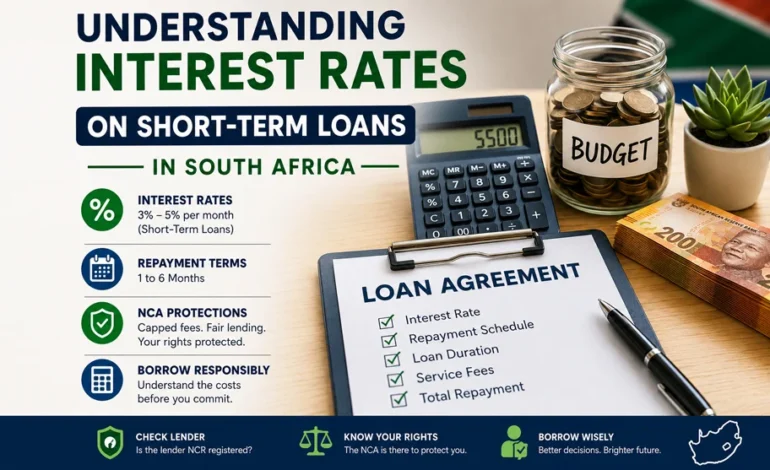
Interest Rates on a loan are the cost of borrowing, which is the amount you pay for borrowing money for a period of time. These interest rates depend on many factors, such as principal, loan duration, your financial profile, and credit score. It is also calculated as a percentage of the basic principal, which is also heavily regulated by the National Credit Regulator. The interest rate for short-term unsecured credit transactions is currently capped at 3% to 5% per month.
Factors Influencing Interest Rates in South Africa
There are several key factors that can affect the exact percentage a lender will offer you while applying for some cash, and knowing these factors can help you figure out why you got the specific interest rate on your quote.
The South African Reserve Bank (SARB) Repo Rate: This is the interest rate that the central bank uses to lend money to commercial banks in South Africa. The SARB changes its repo rate to try to keep inflation in check. As a result, it directly influences the interest rate charged by the lender across the credit market.
Individual Credit Score / Creditworthiness: Your personal history with handling debt is a major factor in the interest rate a lender will give you. They assess your credit profile with bureaus like TransUnion or Experian, and you can expect a lower interest rate if you have a high credit score.
Loan amount and duration: The actual sum of cash you are borrowing and how long it’s going to take you to repay it play a major role in influencing your interest rate. Smaller, short-term loans tend to have their monthly interest capped because the lender is trying to make a profit and cover their costs within a short timeframe.
Lender-specific risk assessments: Every bank and credit provider has its own way of scoring applicants and assessing risk. For instance, a big bank is going to evaluate you using different criteria than some online short-term lender. That’s why two people can get significantly different quotes from different lenders, even after having the same profile.
Repayment Terms Explained
The repayment term for short-term loans in South Africa ranges from 1 to 6 months, meaning you will mostly have to pay high monthly payments. The loan tenure is how much time the loan is going to take to repay, which also heavily affects the total cost of credit. The longer your loan term is, the more interest you will have to pay, so a longer loan term has a higher total cost of the loan.
Short-Term vs. Long-Term Loans: Key Differences
Discover the key difference between long-term loans and short-term loans, including the duration, interest rate, and principal, so you can choose the best option for yourself:
| Key Factors | Short-Term Loans | Long-Term Loans |
| Loan Duration | 1 to 6 Months | 12 to 84 months |
| Interest Rate | 3% to 5% per month | 12.50% to 29.25% per annum |
| Application Complexity | Can be applied within minutes with minimal document requirement | Take a longer time and rigorous paperwork for application |
| Maximum Principal Amount | Up to R8,000 | Up to R500,000 |
What is the disadvantage of a short-term loan?
Even though short-term loans are really convenient, there are also many good reasons for not taking them, which include:
- High interest rate: It is not the same everywhere, but most lenders charge really high interest rates that can go upwards of 60% per annum, touching the maximum limit of short-term loans.
- Credit sizes will be limited: As an unsecured loan, the principal amount is limited to R8,000 by most lenders, which is an important factor to consider while taking them.
- Borrowing can also become a cycle: Higher interest rates and shorter repayment terms make them really difficult to repay in a timely manner, which forces you to take another loan. It creates a debt trap, which becomes deeper and deeper as time goes on and interest stacks.
- Potential damage to the Credit Score: An ongoing short-term loan significantly increases your debt-to-income ratio, which can lower your credit score, making it difficult to take loans from a legitimate lender.
What is the importance of understanding loan terms?
Understanding loan terms is important for responsible borrowing, as you should ensure that you understand all terms, such as interest rate, repayment schedule, and loan duration, carefully before signing the loan agreement. This is necessary for your financial well-being because after reading the loan agreement carefully and understanding the consequences of a default, you can make informed financial decisions.
How to Calculate Interest and Repayments?
The simple interest for the loans is calculated through this mathematical formula: SI = P × R × T, which you can even use to calculate the interest by yourself.
In this formula, P indicates principal, R indicates interest rate, and T is used as the duration of the loan. However, to use this formula, the first thing you need to do is convert the interest rate into decimal form by dividing it by 100.
For example, if you’ve borrowed R5,000 for 5 months at 3% interest per month, calculate the interest like this:
- First, convert the interest rate to a decimal by dividing 3 by 100, which gives 0.03.
- Multiply the principal by the interest rate: 5,000 * 0.03 = 150.
- Then multiply that by the loan duration: 150 * 5 = 750.
- R750 is the overall interest or the total cost of the loan that you would have to repay to completely repay the loan.
Why are more South Africans turning to non-bank lenders for short-term loans?
South Africans are turning to non-bank lenders for short-term loans primarily because of the increased cost of living and stagnant wages. Around 36% of people in South Africa suffer from having an impaired credit score, which makes it really difficult for them to get a loan from traditional banks.
However, non-bank lenders cater to these individuals as well as people working in informal sectors, because they use recent bank statements to verify affordability instead of a traditional credit score. It is again amplified by the strict lending requirements and higher rejection rates of banks, which force people to seek alternative non-banking options.
Some FAQs
How can I verify if a short-term lender is compliant with the National Credit Regulator (NCR)?
The most reliable way to verify a short-term lender is by searching their trading name and registration number, then searching it on NCR’s official website. If the records shown on the website match your lender’s profile, then you are dealing with a legitimate credit provider.
What protections does the National Credit Act (NCA) offer if I am struggling to repay a short-term loan?
If you are struggling to repay a short-term loan, the NCA has provided various legal protections to help you in this situation. Even if you cannot meet your debt repayments, you still have the legal right to apply for a Debt Review through a registered debt counselor. The lender cannot take any legal action or repossess your assets if a reconstructed repayment plan has been negotiated.
Do I have to pay less interest if I repay a short-term loan early?
Yes, you can lower the overall interest rate by repaying a short-term loan early, as this way you will not have to pay the interest rate. However, you should verify whether your lender charges an early repayment fee or not.
What are the legal limits on interest rate and service fees for small loan agreements?
The NCA has put a maximum interest rate and service fees for small loans, which come under the category of Short-term unsecured credit transactions. The interest rate for these loans is capped at 5% per month for the first loan and 3% for any subsequent loan in the same year. They have also put the cap on the initiation fee to R165 per agreement, plus 10% of the amount in excess of R1,000 to a maximum of R1,050, and the monthly service fee is capped at R69.
What is the maximum interest rate for unsecured online loans?
In South Africa, the maximum interest rate for unsecured online loans is capped by the National Credit Act at 28.5% per annum. However, you will not have to pay the maximum interest every time, as the exact interest rate will depend on your income and financial profile.
What is the “In Duplum” rule and how does it protect me?
The “In Duplum” rule in South Africa, which says the interest cannot exceed the outstanding principal of the loan, protects you from unsecured online loans by stopping the interest from snowballing indefinitely.
Disclaimer:
CoreLoans’s article is intended only for general informational and educational purposes, and it should not be taken as a substitute for formal financial advice. Credit regulations, pricing caps, and interest rate thresholds change based on South African Reserve Bank adjustment updates. So, always read the pre-agreement statement and quotation carefully before signing any credit contract.

George Desipris is an expert and passionate freelance content writer with 10+ years of experience in creating informative content for various websites, blogs, and other platforms. George is specialized in niche related to finance, especially in investment and trade.
Their writing hook the readers and never let them to search more about the topic. His articles also featured on various news websites like New York Times and Bloomberg. In addition, George Desipris enjoy chess and badminton like sports. He is always try to broaden their knowledge and vision by using his creativity skills.





1 Comment
[…] Understand your repayment to ensure due date aligns with your paycheck and supports cash flow. […]